
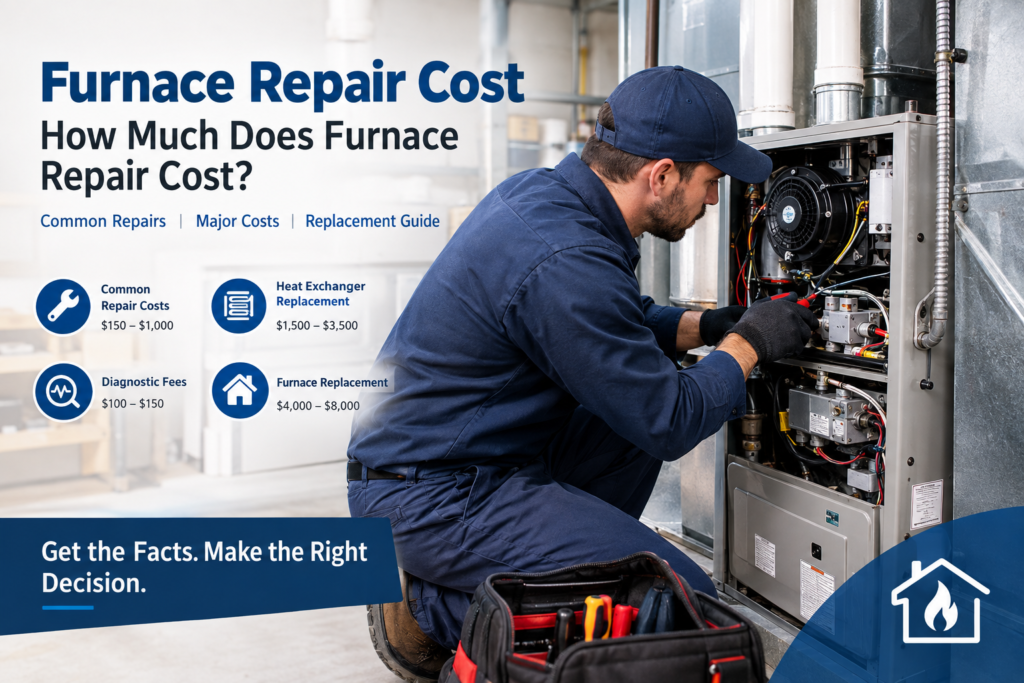
This furnace repair guide explains typical repair prices from $150 to $1,000, major heat exchanger costs of $1,500 to $3,500, diagnostic fees, labor, emergency service, and furnace replacement costs of $4,000 to $8,000. We provide furnace diagnosis, repair, maintenance, and replacement guidance, helping homeowners understand repair options, compare quotes, identify major problems, and make informed decisions based on furnace age, condition, safety, and repair requirements.
Furnace Repair Cost: What You Can Expect to Pay
When your furnace stops working, knowing the likely furnace repair cost can help you decide what to do next. Standard furnace repairs typically range from $150 to $1,000, depending on the failed component, labor, and service requirements. Major repairs, such as replacing a heat exchanger, can cost approximately $1,500 to $3,500.
The actual price depends on the furnace’s age, type, brand, repair complexity, and whether you need regular or emergency service. A professional inspection can identify the problem and provide a clear furnace repair estimate before work begins.
Our furnace services include professional diagnosis, repairs, maintenance, and furnace replacement guidance. We focus on identifying the actual problem, explaining your options, and helping you understand the expected cost before unnecessary parts are replaced.
Average Furnace Repair Cost:
The average furnace repair cost is generally between $150 and $1,000 for common repairs and standard parts and labor. Some simple component replacements cost less, while major repairs can exceed $1,000.
A diagnostic or service call commonly adds $100 to $150 before repair work begins. Emergency, weekend, and after-hours appointments may cost more because they usually involve premium labor or call-out rates.
Average Cost by Common Furnace Repair:
| Furnace Repair | Typical Cost |
| Flame sensor | $80–$240 |
| Thermostat | $100–$600 |
| Furnace ignitor | $100–$300 |
| Limit switch | $100–$375 |
| Pressure switch | $150–$350 |
| Control/circuit board | $300–$650 |
| Blower motor | $300–$1,000 |
| Gas valve | $200–$1,000 |
| Inducer motor | $400–$1,100 |
| Heat exchanger | $1,500–$3,500 |
These are general pricing ranges rather than guaranteed quotes. Your final price can change based on the furnace model, replacement part, labor requirements, accessibility, and local service rates.
Furnace Repair Cost by Common Problem:
Different furnace components have very different replacement prices. A technician should diagnose the problem before recommending a part because similar symptoms can come from completely different faults.
Furnace Ignitor Replacement Cost:
A faulty ignitor can prevent a gas furnace from lighting properly. Ignitor replacement generally falls around $100 to $300. The final price depends on the furnace model, part availability, and labor. If your furnace repeatedly attempts to start but does not ignite, professional testing can determine whether the ignitor is actually responsible or whether another component is causing the problem.
Furnace Blower Motor Repair Cost:
The blower motor moves heated air through your home’s ductwork. A damaged or failed motor can cause weak airflow, unusual noises, or a furnace that overheats and shuts down. Blower motor repairs or replacement usually cost $300 to $1,000. Variable-speed or specialized motors may increase the total price.
Furnace Thermocouple Replacement Cost:
A thermocouple is commonly found in older gas furnaces with standing pilot systems. It helps confirm that the pilot flame is present. If the pilot will not stay lit, the thermocouple may be faulty, although the problem can also involve the pilot assembly or gas supply. A technician should test the system before replacing the component.
Furnace Flame Sensor Replacement Cost:
A dirty or defective flame sensor can allow the burner to ignite and then cause the furnace to shut down shortly afterward. A flame sensor repair or replacement typically costs around $80 to $240. Cleaning may be sufficient in some situations, while a damaged sensor may need replacement.
Furnace Heat Exchanger Repair Cost:
The heat exchanger is one of the most important components in a gas furnace because it separates combustion gases from the air circulated through your home. A furnace heat exchanger repair can become one of the most expensive furnace services. Replacement costs can range from approximately $1,500 to $3,500.
If you are asking, how much does it cost to replace a furnace heat exchanger, the answer depends on the furnace model, part availability, labor, and installation complexity. A professional inspection is particularly important when a cracked heat exchanger is suspected because combustion and carbon monoxide safety must be considered.
Furnace Thermostat Replacement Cost:
A thermostat controls when your furnace starts and stops heating. A faulty thermostat may cause inconsistent temperatures, short cycling, or prevent the furnace from responding correctly. Thermostat replacement generally ranges from $100 to $600, depending on the thermostat type and installation requirements. Smart and advanced communicating thermostats can cost more than basic models.
Furnace Gas Valve Replacement Cost:
The gas valve controls the flow of gas to the furnace burners. Because this component is part of the fuel system, diagnosis and replacement should be handled by a qualified professional. Gas valve replacement can cost approximately $200 to $1,000, depending on the furnace and replacement component.
Furnace Limit Switch Replacement Cost:
A limit switch monitors furnace temperature and helps protect the system from overheating. A failed switch can cause the furnace to shut down unexpectedly. Typical limit-switch replacement costs range from $100 to $375. However, the underlying cause of overheating should also be investigated rather than simply replacing the switch.
Furnace Pressure Switch Replacement Cost:
The pressure switch helps confirm that the furnace’s venting and combustion system is operating correctly. A failed pressure switch can prevent a furnace from starting or cause repeated shutdowns. Replacement commonly costs approximately $150 to $350, although diagnosis is necessary because blocked venting, condensate problems, or other issues can create similar symptoms.
Furnace Inducer Motor Replacement Cost:
The inducer motor helps move combustion gases through the furnace’s venting system. When it fails, the furnace may produce unusual noises or fail to complete its startup sequence. Inducer motor replacement can cost approximately $400 to $1,100, depending on the equipment and required labor.
Furnace Repair Cost by Furnace Type:
The furnace repair cost by furnace type varies based on the system’s design, components, repair needs, parts, and labor required.
Gas Furnace Repair Cost:
Gas furnaces contain components such as ignitors, flame sensors, gas valves, pressure switches, inducer motors, and heat exchangers. The repair price depends more on the failed component than simply the fact that the furnace uses gas. Because gas equipment involves combustion, repairs involving fuel, burners, venting, or heat exchangers should be handled professionally.
Electric Furnace Repair Cost:
Electric furnaces do not use gas valves or combustion heat exchangers, but they can still experience problems with heating elements, blowers, thermostats, limit switches, circuit boards, and electrical controls. The cost depends on which component has failed and how much labor is required to access and replace it.
Oil Furnace Repair Cost:
Oil furnaces have expert burners, fuel systems, controls, and other components. Repairs may require technicians with experience servicing oil-fired heating equipment. Cleaning, maintenance, parts availability, and the specific fault can all influence the final repair quote.
High-Efficiency Furnace Repair Cost:
High-efficiency furnaces can include more advanced controls and components than older conventional systems. Some replacement parts may therefore be more expensive. When evaluating a high-efficiency furnace cost, consider both the initial equipment price and the potential long-term energy savings, maintenance requirements, and available warranty coverage.
What Factors Affect Furnace Repair Cost?
Several factors determine the final price of a furnace repair.
- Type of repair: A flame sensor or ignitor is generally less expensive than a blower motor, inducer motor, or heat exchanger.
- Replacement parts: The price and availability of the required component can significantly affect the bill.
- Labour: Some repairs are quick, while others require extensive disassembly or testing.
- Furnace age: Older equipment may have discontinued or harder-to-find parts.
- Brand and model: Particular components can cost more than common replacement parts.
- Accessibility: A furnace located in a difficult-to-access area can take longer to service.
- Emergency service: Nights, weekends, holidays, and severe-weather emergencies may involve premium rates.
- Warranty coverage: A manufacturer warranty may cover eligible components but leave the homeowner responsible for labour or service charges.
Furnace Repair Cost by Labor and Service Fees
- Furnace Diagnostic Fee: Before repairing a furnace, a technician normally needs to identify the actual fault. A standard diagnostic or service-call fee is often around $100 to $150. Ask whether the diagnostic charge is separate from the repair price or whether the company applies it toward approved repair work.
- Furnace Labor Cost Per Hour: Labor is an important part of your total furnace service costs. The amount depends on local rates, the technician’s experience, the repair complexity, and the time required. An specified quote should make it easier to understand how much you are paying for parts, labor, and service.
- Emergency Furnace Repair Cost: The emergency furnace repair cost can be higher than a normal appointment. After-hours, weekend, holiday, or extreme-weather calls may involve additional service charges or premium labor rates. If the furnace presents a safety concern or your home has no reliable heat during severe weather, professional assistance may be necessary rather than waiting for standard business hours.
- Weekend and After-Hours Furnace Repair Cost: Weekend and after-hours repairs can carry additional fees. Before requesting emergency service, ask the company about the call-out charge, hourly rate, diagnostic fee, and expected repair cost. This helps you avoid surprises when reviewing the final invoice.
Furnace Repair vs. Furnace Replacement Cost:
A repair may be the practical choice when the furnace is relatively reliable and the failed component is affordable. Replacement becomes more important to consider when the equipment is old, inefficient, frequently breaking down, or facing a major repair.
| Factor | Furnace Repair | Furnace Replacement |
| Upfront cost | Usually lower | Usually higher |
| Best for | Minor or moderate problems | Major or repeated problems |
| Lifespan impact | Can extend existing equipment | Provides a new system |
| Energy efficiency | Depends on existing furnace | New equipment may be more efficient |
| Parts availability | Depends on furnace age | New equipment has current parts |
| Long-term planning | May delay replacement | Resets equipment lifespan |
Full furnace replacements generally range from approximately $4,000 to $8,000, including installation, although the final price depends on equipment selection, installation requirements, and local market conditions.
So, how much is a furnace replacement? A realistic planning range is around $4,000–$8,000 for a complete installed system, but homeowners should obtain a detailed local quotation before making a decision.
Is It Worth Repairing an Old Furnace?
Age is an important factor when deciding whether to repair or replace a furnace. If a furnace is more than 12–15 years old and requires a repair costing more than $1,000, it may be worth comparing the repair with replacement.
However, age alone should not determine the decision.
Consider:
- Furnace age
- Previous repair history
- Current repair price
- Energy efficiency
- Safety condition
- Availability of replacement parts
- Manufacturer warranty
- Expected remaining service life
For example, spending $200 on a relatively minor repair may make sense for an otherwise reliable older furnace. A $1,500–$3,500 heat exchanger repair requires a much more careful furnace repair vs replacement comparison.
How to Save Money on Furnace Repair
There are several ways to control unnecessary repair expenses.
Get Multiple Estimates:
For an expensive repair, compare quotes from more than one qualified HVAC company. Make sure each company is quoting the same repair and part.
Ask for an Itemized Quote:
A detailed furnace repair quote should identify the diagnosis, parts, labor, service fees, and applicable warranty.
Compare Repair and Replacement:
If your furnace is older and the repair is expensive, ask for both repair and replacement options. This gives you a clearer view of the long-term cost.
Schedule Preventive Maintenance:
Regular maintenance can help identify developing problems before they become major failures. A furnace tune-up may also help maintain safe and efficient operation.
Check Warranty Coverage:
Before paying for an expensive part, check whether your furnace or component is still covered by a manufacturer’s warranty.
Avoid Unnecessary Part Replacements:
A symptom does not always identify the failed component. For example, a furnace that does not start may have an ignition, thermostat, pressure, control, or electrical issue. Proper diagnosis helps prevent replacing parts that are still working.
When Should You Replace Instead of Repairing Your Furnace?
Replacement deserves serious consideration when you experience frequent breakdowns, major repair bills, poor heating performance, rising energy costs, or repeated component failures. A furnace that is 12–15 years old or more may also require a closer comparison between continued repairs and a new system.
You should also consider replacement when a major component such as a heat exchanger has failed and the repair approaches a substantial portion of the cost of a new furnace. The best decision depends on the equipment’s condition, repair history, efficiency, safety, warranty, and your long-term heating needs.
How to Know if a Furnace Repair Quote Is Reasonable:
A furnace repair estimate is easier to evaluate when it clearly explains what has failed and what you are paying for.
Ask these questions before approving the work:
- What component has failed?
- What caused the failure?
- Is replacement necessary?
- What is the part cost?
- How much is labor?
- Is the diagnostic fee included?
- Is the replacement part covered by warranty?
- What warranty comes with the repair?
- Would replacement be more practical because of the furnace’s age?
If you are wondering, what is a fair furnace repair price, compare itemized estimates rather than comparing only the total. A $900 quote may include a premium part, several hours of labor, diagnosis, and warranty, while a cheaper quote may exclude some of these services.
This is particularly important when evaluating a free furnace repair estimate. Ask what the company means by “free.” The estimate itself may be free while diagnostic testing or emergency service has a separate charge.
Frequently Asked Questions:
How much does furnace repair cost?
The typical furnace repair cost is approximately $150 to $1,000 for standard repairs and parts. Major repairs, such as heat exchanger replacement, can range from approximately $1,500 to $3,500.